
Italy Increases Student Visa Financial Requirement to €10,179.85: What International Students Need to Know in 2026
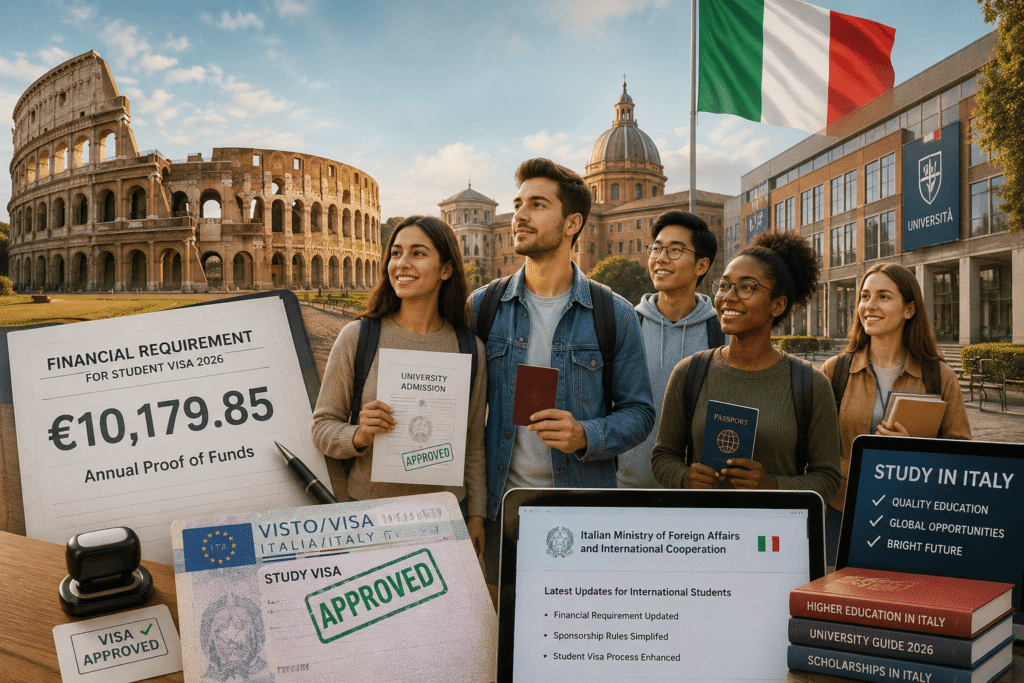
Italy has officially increased the minimum financial requirement for international students applying for long-term study visas, setting the annual proof of funds threshold at €10,179.85 for 2026.
The update is significant for thousands of prospective students planning to study in Italy, particularly applicants from Pakistan, India, Bangladesh, Nepal, and other major student-sending countries. Financial documentation remains one of the most scrutinized aspects of the Italian student visa process, and this increase means students must prepare stronger financial evidence before lodging their applications.
For students targeting the September 2026 and January 2027 intakes, understanding these new requirements early can help avoid delays, refusals, and unnecessary complications during visa processing.
Why Has Italy Increased the Financial Requirement?
Like many European countries, Italy periodically adjusts student visa financial thresholds to reflect:
Inflation and rising living costs
Housing expenses across major Italian cities
Student welfare considerations
Economic conditions within the European Union
Cost-of-living sustainability for international students
Italian authorities want to ensure that students arriving in the country can financially support themselves without becoming dependent on public assistance or facing financial hardship during their studies.
The new threshold of €10,179.85 per year is intended to represent a realistic minimum amount required for living expenses while studying in Italy.
What Is the New Italy Student Visa Financial Requirement for 2026?
Updated Minimum Financial Requirement
| Requirement | Amount |
|---|---|
| Annual Financial Proof | €10,179.85 |
| Monthly Equivalent | Approximately €848 |
| Daily Equivalent | Approximately €28 |
Applicants must demonstrate access to sufficient funds covering their stay in Italy.
These funds may generally be shown through:
Personal bank statements
Parent-sponsored bank statements
Family sponsor documentation
Scholarship awards
Educational grants
Financial guarantees accepted by Italian authorities
Students should always verify requirements through the relevant Italian Embassy or Consulate before submission.
Italy’s New Sponsorship Flexibility: A Positive Development
One of the most important updates accompanying recent visa policy discussions is increased flexibility regarding sponsors.
Traditionally, Italian authorities preferred:
The applicant themselves
Immediate parents
However, recent practices have shown greater flexibility where applicants can sometimes be supported by relatives up to the fourth degree of relationship, subject to proper documentation and financial evidence.
Potential sponsors may include:
Parents
Grandparents
Siblings
Uncles
Aunts
First cousins (depending on circumstances and supporting documents)
Applicants must still provide:
Relationship proof
Affidavits where required
Financial capacity evidence
Source of income documentation
This flexibility could benefit many Pakistani families where educational funding often comes from extended family networks.
How Does This Affect International Students?
Increased Financial Planning Requirements
Students who previously budgeted based on older financial thresholds must now reassess their finances.
The increase means:
Larger bank balances may be required
Financial documents must be stronger
Savings plans should begin earlier
Sponsors may need additional documentation
Applicants should avoid last-minute deposits that may raise concerns during document assessment.
Greater Scrutiny of Financial Documents
Italian visa officers increasingly examine:
Transaction history
Source of funds
Consistency of income
Sponsor credibility
Financial stability over time
Simply meeting the minimum amount may not always be sufficient if supporting evidence appears weak or inconsistent.
Impact on Pakistani Students
Italy continues to attract Pakistani students because of:
Affordable public universities
Relatively lower tuition fees compared to many Western countries
Scholarship opportunities
Post-study work options
Growing demand for skilled workers
However, the increased financial requirement means Pakistani applicants should begin preparing financial documentation well in advance.
Students planning to study in Italy should focus on:
Strong Banking History
Maintaining stable bank statements over several months can significantly strengthen a visa application.
Proper Sponsor Documentation
Where sponsors are involved, applicants should prepare:
Income tax records
Salary certificates
Business registration documents
Bank statements
Relationship certificates
Accurate Financial Declarations
Any discrepancies between declared income and available funds may create complications during visa assessment.
Cost of Living in Italy in 2026
The new financial threshold reflects real-world living expenses faced by students.
Average monthly student expenses may include:
| Expense Category | Estimated Cost |
|---|---|
| Accommodation | €300–€700 |
| Food | €150–€300 |
| Transportation | €25–€60 |
| Utilities | €50–€150 |
| Miscellaneous | €100–€250 |
Major cities such as:
Milan
Rome
Florence
Bologna
typically require higher budgets than smaller Italian towns.
Students should budget beyond the minimum visa requirement whenever possible.
What Does This Mean for Work Visa Applicants?
Although the announcement specifically targets student visa applicants, it indirectly highlights broader immigration trends.
European governments are increasingly emphasizing:
Financial self-sufficiency
Genuine applicant assessment
Strong documentation standards
Compliance with immigration rules
Future work visa applicants can expect similar scrutiny regarding:
Salary thresholds
Employment contracts
Financial credibility
Residence requirements
Those planning long-term migration pathways should begin building strong financial records early.
Implications for Permanent Residency Aspirants
Many international students view Italy as a stepping stone toward:
Employment opportunities
Long-term residence
European mobility
Permanent residency pathways
The updated financial requirement reinforces the importance of demonstrating financial stability from the beginning of an applicant’s journey.
Maintaining legal status, financial compliance, and proper documentation throughout studies can positively influence future immigration applications.
Expert Analysis: What Students Should Do Now
From an immigration advisory perspective, students targeting Italy in 2026 should take the following steps immediately:
Start Financial Preparation Early
Do not wait until admission results arrive.
Build financial evidence several months before visa submission.
Maintain Consistent Bank Records
Avoid large unexplained deposits shortly before application.
Organize Sponsor Documentation
Ensure sponsors can clearly demonstrate:
Income sources
Financial stability
Relationship with the student
Consider Scholarship Opportunities
Scholarships can significantly strengthen a visa application while reducing financial pressure.
Prepare for Embassy Verification
Applicants should assume that supporting documents may be verified.
Accuracy and transparency remain essential.
Frequently Asked Questions (FAQs)
Is the new Italy student visa financial requirement mandatory?
Yes. Applicants must demonstrate sufficient financial resources according to the latest threshold established for student visa applications.
How much money is required for an Italy student visa in 2026?
The annual financial requirement has been updated to €10,179.85.
Can my parents sponsor my studies in Italy?
Yes. Parents remain among the most commonly accepted sponsors for Italian student visa applications.
Can an uncle or aunt sponsor my Italy study visa?
Recent policy flexibility may allow sponsorship from extended family members, provided proper documentation and financial evidence are submitted.
Does a scholarship reduce the financial requirement?
Scholarships may help satisfy financial support requirements depending on their value and official documentation.
Are bank statements required for an Italy student visa?
Yes. Financial documentation is typically a core requirement during the visa process.
Does meeting the minimum amount guarantee visa approval?
No. Visa officers assess the overall application, including academic documents, financial evidence, sponsor credibility, and applicant intentions.
Is Italy still affordable for international students?
Compared to many Western European destinations, Italy remains one of the more affordable study destinations, particularly outside major cities.
Can students work while studying in Italy?
International students are generally permitted limited work opportunities subject to applicable regulations.
Can studying in Italy lead to permanent residency?
Long-term lawful residence, employment, and compliance with immigration rules may contribute toward future residency pathways.
Conclusion
Italy’s decision to increase the student visa financial requirement to €10,179.85 reflects the country’s effort to align immigration policies with current living costs and ensure international students can comfortably support themselves during their studies.
While the update raises the financial threshold, Italy remains one of Europe’s most attractive destinations for international education due to its globally recognized universities, affordable tuition fees, scholarship opportunities, and potential pathways toward employment and long-term residence.
Students planning for upcoming intakes should begin preparing financial documents early, maintain transparent banking records, and ensure sponsor documentation is complete and credible. Proper planning today can significantly improve visa success rates tomorrow.