New Zealand Skilled Migrant Category 2026: Complete Guide
New Zealand’s Skilled Migrant Category (SMC) 2026 is one of the country’s main residence pathways for skilled professionals, experienced workers and selected trades and technicians.
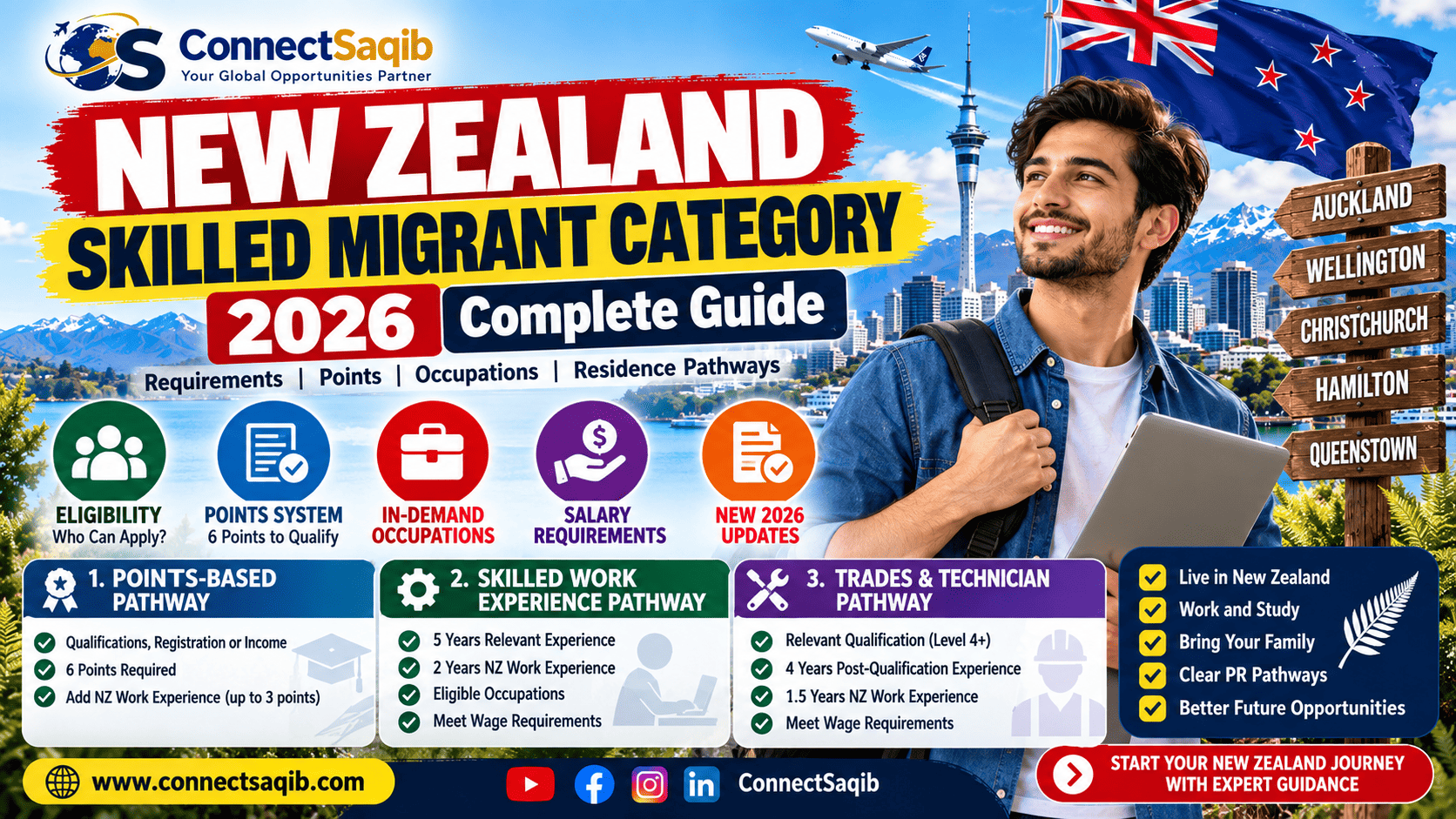
The SMC has undergone important changes in 2026. From 24 August 2026, New Zealand introduced new Skilled Work Experience and Trades and Technician pathways, revised qualification points, updated wage settings and introduced a new recognised occupational-registration pathway for certain accountants.
The current system is therefore broader than the traditional six-point qualification route.
Depending on your profile, you may qualify through:
- The Points-based pathway
- The Skilled Work Experience pathway
- The Trades and Technician pathway
You only need to meet the requirements of one of these pathways.
This complete guide explains the New Zealand Skilled Migrant Category 2026, including eligibility, points, salary requirements, qualifications, work experience, English requirements, age limits, AEWV connections, application process and residence options.
What Is the New Zealand Skilled Migrant Category?
The Skilled Migrant Category Resident Visa is a residence visa for people who have skills New Zealand needs.
If approved, the visa allows you to:
- Live in New Zealand indefinitely
- Work in New Zealand
- Study in New Zealand
- Include your partner
- Include dependent children aged 24 or younger
- Potentially apply for a Permanent Resident Visa later if you meet the requirements.
The SMC is particularly relevant to people who have:
- Recognised qualifications
- Eligible occupational registration
- High income
- Significant skilled work experience
- Eligible trade or technician experience
New Zealand Skilled Migrant Category 2026 Changes
The 2026 changes are important for anyone planning to apply under the SMC.
From 24 August 2026, Immigration New Zealand introduced:
- New Skilled Work Experience pathway
- New Trades and Technician pathway
- Updated qualification points
- New qualification evidence requirements
- Revised wage-threshold settings
- Extended English-test validity for certain applicants with recognised occupational registration
- A new recognised occupational registration for qualifying accountants
- Red and Amber occupation lists for the new pathways.
These changes mean applicants should not rely on older SMC guides published before August 2026.
The 3 Skilled Migrant Category Pathways in 2026
There are now three main ways to qualify.
| Pathway | Designed For | Main Requirement |
|---|---|---|
| Points-Based | Qualified, registered or highly paid workers | 6 points |
| Skilled Work Experience | Experienced skilled workers | 5 years relevant experience + 2 years NZ experience |
| Trades & Technician | Eligible trades/technical workers | Relevant qualification + work experience |
Applicants only need to qualify under one pathway.
Let’s examine each pathway.
1. SMC Points-Based Pathway
The Points-based pathway is designed for applicants who can claim skilled resident points from:
- Qualifications
- Occupational registration
- Income
You need 6 points to qualify.
You can claim between 3 and 6 points from one skill category, and if necessary, add up to three points from skilled work experience in New Zealand.
Important SMC points rule
You cannot combine qualification points with income points.
For example, you cannot take four points from a bachelor’s degree and two points from income.
Instead, you select one primary skill category and can then add eligible New Zealand skilled work experience points if required.
SMC Qualification Points 2026
Qualification points depend on whether your qualification was obtained in New Zealand or overseas.
New Zealand qualifications
| Qualification | Points |
|---|---|
| Level 10 Doctoral Degree | 6 |
| Level 9 Master’s Degree, 30 weeks full-time | 6 |
| Level 9 Master’s Degree, other | 5 |
| Level 8 Honours / PG Diploma / PG Certificate | 5 |
| Level 7 Bachelor’s Degree | 5 |
A New Zealand master’s degree can provide six points if the applicant completed at least 30 weeks of full-time study in New Zealand and has a bachelor’s degree.
Overseas qualifications
| Qualification | Points |
|---|---|
| Level 10 Doctoral Degree | 6 |
| Level 9 Master’s Degree | 5 |
| Level 8 Honours / PG Diploma / PG Certificate | 4 |
| Level 7 Bachelor’s Degree | 4 |
For overseas qualifications, an International Qualification Assessment (IQA) is generally required unless the qualification is on the applicable exemption list.
This is particularly important for applicants from countries such as Pakistan because an overseas degree should not automatically be assumed to have the same New Zealand qualification level.
How New Zealand Work Experience Adds SMC Points
If your qualification, occupational registration or income gives you fewer than six points, you may be able to add points from skilled work experience in New Zealand.
The current system allows:
| New Zealand Skilled Work Experience | Points |
|---|---|
| 1 year | 1 |
| 1.5 years | 2 |
| 2 years | 3 |
You can claim a maximum of three additional points from New Zealand skilled work experience.
Example
An overseas bachelor’s degree can provide 4 points.
If the applicant then completes 2 years of eligible skilled work in New Zealand, they may be able to claim another three points and reach six.
The exact employment and wage requirements must still be satisfied.
SMC Points Through Occupational Registration
Certain New Zealand occupational registrations can provide SMC points.
Examples include regulated professions such as:
- Chartered accountants
- Plumbers
- Certain healthcare professionals
- Other eligible registered occupations
The number of points depends on the minimum training or experience required for the registration.
| Training/Experience Required for Registration | Points |
|---|---|
| 6 years | 6 |
| 5 years | 5 |
| 4 years | 4 |
| 2 years | 3 |
Only occupational registrations specifically recognised by Immigration New Zealand can be used for SMC points.
New Accountant Registration Pathway in 2026
One notable 2026 change affects accountants.
From 24 August 2026, accountants who can undertake the work of a Qualified Statutory Accountant in New Zealand and hold membership with CPA Australia can qualify under the recognised occupational-registration provisions of the SMC.
This could be significant for experienced international accounting professionals, but membership alone does not mean an applicant automatically qualifies for residence.
The applicant must satisfy the specific immigration and registration requirements.
SMC Points Through Income
Highly paid workers can also claim points based on their income.
For the current SMC settings, the wage threshold is NZD $35 per hour for the relevant ANZSCO skill levels 1–3 pathway.
Income points are currently structured as:
| Salary Rate | Points |
|---|---|
| NZD $52.50/hour or more | 3 |
| NZD $70/hour or more | 4 |
| NZD $105/hour or more | 6 |
These figures are based on the current SMC wage threshold of NZD $35/hour.
For an annual salary, the hourly equivalent depends on the maximum contracted hours in the employment agreement.
For example, at 40 hours per week:
- NZD $52.50/hour ≈ NZD $109,200/year
- NZD $70/hour ≈ NZD $145,600/year
- NZD $105/hour ≈ NZD $218,400/year
These calculations are illustrative; applicants should use the official Immigration New Zealand calculation method for their employment arrangement.
2. Skilled Work Experience Pathway
The new Skilled Work Experience pathway is particularly relevant to experienced workers who may not have enough qualification or registration points.
To use this pathway, applicants generally need:
- A skilled occupation at ANZSCO skill level 1–3
- A job or job offer meeting the applicable wage requirement
- At least 3 years of relevant work experience
- An additional 2 years of skilled work experience in New Zealand
- The required wage level during the qualifying New Zealand experience.
The current standard wage requirement for this pathway is 1.1 times the SMC wage threshold.
From 9 March 2026, this is NZD $38.50 per hour for the standard Skilled Work Experience pathway.
Simple example
A skilled worker could potentially follow this structure:
3 years relevant overseas experience
↓
2 years qualifying skilled employment in New Zealand
↓
Meet the required wage and occupation conditions
↓
Apply through the Skilled Work Experience pathway
This pathway is useful because it does not depend entirely on having a high-level academic qualification.
Red and Amber Occupations
The new Skilled Work Experience pathway includes additional rules for certain occupations.
Red List
Occupations on the Red List cannot use the two new pathways.
However, workers in those occupations may still qualify under an existing SMC pathway if they meet requirements such as:
- A qualifying bachelor’s degree or higher
- Eligible occupational registration
- Sufficient income
or another qualifying route.
Amber List
Amber occupations can use the Skilled Work Experience pathway but face additional requirements.
Applicants generally need:
- At least five years of relevant eligible work experience
- Two years of skilled New Zealand work experience
- At least 1.2 times the SMC median wage during the qualifying New Zealand experience.
The Red and Amber lists can be reviewed and changed, so applicants should check the current occupation list before applying.
3. Trades and Technician Pathway
The new Trades and Technician pathway is designed for skilled practical and technical workers.
Examples of relevant sectors can include:
- Construction
- Engineering
- Manufacturing
- Automotive
- Technical services
To qualify, applicants need:
- An eligible occupation
- A relevant Level 4 or higher qualification
- At least four years of directly relevant post-qualification work experience
- At least 1.5 years of qualifying skilled work experience in New Zealand
- The required wage.
The current Trades and Technician pathway wage threshold is NZD $35 per hour for experience beginning from 9 March 2026.
This pathway provides another option for experienced technical workers who may not have a university degree.
Who Can Apply for the Skilled Migrant Category?
The SMC is potentially relevant to applicants who have:
- A skilled New Zealand job
- A qualifying New Zealand job offer
- A recognised qualification
- Eligible occupational registration
- High income
- Significant relevant work experience
- An eligible trade or technician occupation
All applicants must satisfy the core residence requirements.
Immigration New Zealand states that applicants generally need a New Zealand job or job offer, must meet the applicable pay requirements, satisfy health and character requirements and be able to speak and understand English.
Does the SMC Require a Job Offer?
Yes.
A skilled job or job offer in New Zealand is an important part of the SMC.
The employer must be accredited by Immigration New Zealand for the relevant skilled employment.
This means having an overseas degree and many years of experience does not by itself guarantee SMC eligibility.
A person planning to migrate through the SMC should normally plan for:
Qualification/skills → New Zealand skilled employment → SMC eligibility → Residence
Can an AEWV Lead to the Skilled Migrant Category?
Yes.
The Accredited Employer Work Visa (AEWV) is a temporary work visa, while the SMC is a residence pathway.
An overseas applicant may obtain an eligible job with an accredited employer, work in New Zealand and then use qualifying New Zealand employment as part of an SMC pathway where the rules allow it.
This is particularly relevant for applicants who need New Zealand skilled work experience to complete their six points or satisfy one of the new experience-based pathways.
Immigration New Zealand also announced that a future ability to extend an AEWV for up to the additional skilled work experience needed for certain SMC applications is scheduled to be introduced in 2027. Further eligibility details are still to be provided.
SMC Salary Requirements 2026
The current SMC wage threshold from 9 March 2026 is:
NZD $35.00 per hour
for the standard ANZSCO skill level 1–3 threshold.
Other pathways use multiples of this amount:
- SMC threshold: NZD $35/hour
- 1.1× threshold: NZD $38.50/hour
- 1.2× threshold: NZD $42/hour
- 1.5× threshold: NZD $52.50/hour
- 2× threshold: NZD $70/hour
- 3× threshold: NZD $105/hour.
The exact rate that applies to an applicant can depend on the pathway and when the qualifying New Zealand work experience started.
Important 2026 Wage-Threshold Change
One of the important SMC changes is how the wage threshold is locked in.
For pathways requiring New Zealand skilled work experience, the relevant threshold is generally the one in effect when the applicant starts gaining qualifying skilled work experience.
If the threshold later increases, the applicant generally does not have to meet the newer higher threshold, provided the applicable requirements continue to be satisfied.
There is also a five-month grace period in certain circumstances where the threshold rises between the grant of a work visa and the start of qualifying skilled work.
This makes it important to keep accurate records of when qualifying employment and qualifying pay began.
English Requirements for New Zealand SMC
Applicants for skilled residence generally need to demonstrate that they can speak and understand English.
Accepted evidence can depend on the applicant’s circumstances and immigration category.
A significant 2026 change concerns applicants with recognised occupational registration.
From 24 August 2026, English-language test results can remain valid for up to five years for applicants who hold eligible recognised occupational registration.
Applicants should check the exact English requirements that apply to their application rather than assuming that an IELTS score is always required.
Age Requirement for Skilled Migrant Category
The SMC has an age requirement.
Applicants must generally be 55 years old or younger when applying for the Skilled Migrant Category Resident Visa.
This is an important factor for professionals considering New Zealand later in their careers.
Applicants should therefore assess their immigration strategy early rather than waiting until they are close to the age limit.
Health and Character Requirements
SMC applicants must satisfy New Zealand’s health and character requirements.
Depending on the circumstances, this can involve:
- Medical examinations
- Chest X-rays
- Police certificates
- Evidence relating to previous immigration or criminal matters
Applicants should provide complete and accurate information.
Immigration New Zealand can request additional evidence where necessary.
Can Pakistani Applicants Apply for the SMC?
Yes.
The Skilled Migrant Category is based primarily on the applicant’s skills, employment, qualifications, registration, income and New Zealand work experience, rather than nationality.
A Pakistani applicant can potentially qualify if they satisfy the relevant SMC pathway.
For Pakistani applicants, important preparation may include:
- Verifying overseas qualifications
- Obtaining an IQA when required
- Preparing employment references
- Demonstrating relevant work experience
- Securing a genuine New Zealand job
- Meeting English requirements
- Meeting health and character requirements.
An overseas qualification does not automatically receive the same New Zealand qualification level, so qualification assessment can be important.
Documents Required for SMC
Applicants should prepare documents relevant to their pathway.
These may include:
Identity
- Passport
- Birth certificate where required
Qualifications
- Degree certificates
- Academic transcripts
- IQA report where required
- Evidence of New Zealand qualifications
Employment
- Employment agreement
- Job offer
- Job description
- Employer details
- Payslips
- Tax records
- Evidence of New Zealand work experience
Registration
- Registration certificate
- Licence
- Professional membership
- Evidence of scope of practice
Other
- English-language evidence where applicable
- Police certificates
- Medical documents
- Evidence for partner and children where included
Immigration New Zealand specifically requires evidence supporting the points claimed in an SMC application.
How to Apply for the New Zealand SMC in 2026
The application process generally involves several stages.
Step 1: Assess Your Profile
Check:
- Age
- Occupation
- Qualification
- Registration
- Salary
- Work experience
- English
- Health
- Character
Step 2: Identify Your SMC Pathway
Determine whether you qualify through:
Points-Based
Skilled Work Experience
or
Trades and Technician
Step 3: Secure Skilled Employment
You generally need a qualifying New Zealand job or job offer from an accredited employer.
Step 4: Gather Evidence
Prepare all documents supporting your qualification, registration, income and work experience.
Step 5: Submit an Expression of Interest
For the Points-based SMC route, an Expression of Interest (EOI) is the first step.
If Immigration New Zealand determines that the EOI meets the requirements, the applicant may receive an Invitation to Apply.
Step 6: Submit the Residence Application
After receiving an invitation, submit the residence application with the required evidence.
Step 7: Await the Decision
Immigration New Zealand assesses the application against the applicable residence requirements.
SMC vs Green List: What’s the Difference?
These pathways are often confused.
| Feature | Skilled Migrant Category | Green List |
|---|---|---|
| Main basis | Skills, qualifications, registration, income/work experience | Specific occupations |
| Points system | Yes, for Points-based pathway | No SMC-style points |
| Tier system | No | Tier 1 & Tier 2 |
| Residence | Skilled residence | Straight or Work to Residence |
| Job required | Yes | Yes |
| Accredited employer | Yes | Yes |
| NZ work experience | Depends on pathway | Required for Tier 2 |
| Suitable for | Broad range of skilled workers | Specific listed occupations |
A person who does not qualify under the Green List may still potentially qualify through the SMC.
Likewise, someone in a Green List occupation may have a more direct residence route depending on the occupation and requirements.
SMC 2026: Example Profiles
Example 1 — Overseas Bachelor’s Degree
An applicant has an eligible overseas bachelor’s degree.
Qualification: 4 points
They may need:
Additional NZ skilled work experience: up to 2 points
The applicant must satisfy the relevant employment and wage requirements.
Example 2 — Overseas Master’s Degree
An eligible overseas master’s degree can provide:
5 points
The applicant may then need:
1 year of qualifying NZ skilled work experience = 1 point
to reach six points.
Example 3 — New Zealand PhD
An eligible Level 10 doctoral degree can provide:
6 points
This can potentially eliminate the need to claim additional work-experience points under the Points-based pathway.
Example 4 — Experienced Skilled Worker
A worker without sufficient qualification points may potentially use the Skilled Work Experience pathway, provided they meet the required occupation, overseas experience, New Zealand experience and wage conditions.
Common SMC Mistakes to Avoid
Mistake 1: Using the Old Points System
The SMC changed significantly in August 2026.
Always use the current points tables.
Mistake 2: Assuming an Overseas Bachelor’s Is Five Points
Under the current 2026 system, an eligible overseas Level 7 bachelor’s degree generally provides 4 points, while a qualifying New Zealand bachelor’s provides 5 points.
Mistake 3: Mixing Qualification and Income Points
You cannot combine points from different primary skill categories.
You select qualification, registration or income and can then add eligible New Zealand skilled work experience.
Mistake 4: Ignoring the Wage Threshold
Your employment must meet the applicable SMC wage requirements.
Mistake 5: Counting Unrelated Experience
Relevant work experience must correspond closely to the relevant occupation.
Mistake 6: Assuming Self-Employment Counts
Self-employment cannot be counted as relevant work experience under the new Skilled Work Experience and Trades and Technician pathways.
Mistake 7: Paying for a Fake Job Offer
A genuine job offer should come from a legitimate accredited employer and meet New Zealand employment and immigration requirements.
New Zealand Skilled Migrant Category 2026 Checklist
Before starting your application, check:
✔ Age 55 or younger
✔ Skilled New Zealand job or job offer
✔ Accredited employer
✔ Correct occupation classification
✔ Qualification or registration
✔ Six points, if using the Points-based pathway
✔ Required New Zealand work experience
✔ Applicable wage threshold
✔ English requirement
✔ Health requirements
✔ Character requirements
✔ Genuine employment
✔ Supporting documentation
Final Thoughts
The New Zealand Skilled Migrant Category 2026 is now a broader residence framework than the traditional six-point system.
The current system provides three pathways: the Points-based pathway, Skilled Work Experience pathway, and Trades and Technician pathway.
For degree holders, the Points-based pathway remains particularly important. An eligible overseas bachelor’s degree can provide four points, an overseas master’s can provide five, and a doctoral degree can provide six. Eligible New Zealand qualifications can receive higher points in several categories.
For experienced workers without sufficient qualification points, the new Skilled Work Experience pathway may provide another route, requiring five years of relevant experience overall, including two years of qualifying skilled work in New Zealand.
For eligible practical and technical professionals, the new Trades and Technician pathway can combine a relevant qualification with post-qualification experience and New Zealand work experience.
The biggest lesson for applicants is that there is no single SMC formula that works for everyone. Your occupation, qualification, registration, salary, work history and New Zealand employment all matter.
Anyone considering New Zealand residence in 2026 should check the current Immigration New Zealand requirements before making financial or employment commitments.