New Zealand Study Visa 2026: Requirements, Costs & Application Process
New Zealand continues to attract international students because of its internationally recognised education system, multicultural environment, strong student support and opportunities to gain practical experience after graduation.
For students planning to study in New Zealand in 2026, obtaining the right student visa is one of the most important steps. The New Zealand Fee Paying Student Visa is the most common option for international students who intend to study full-time and pay international tuition fees.
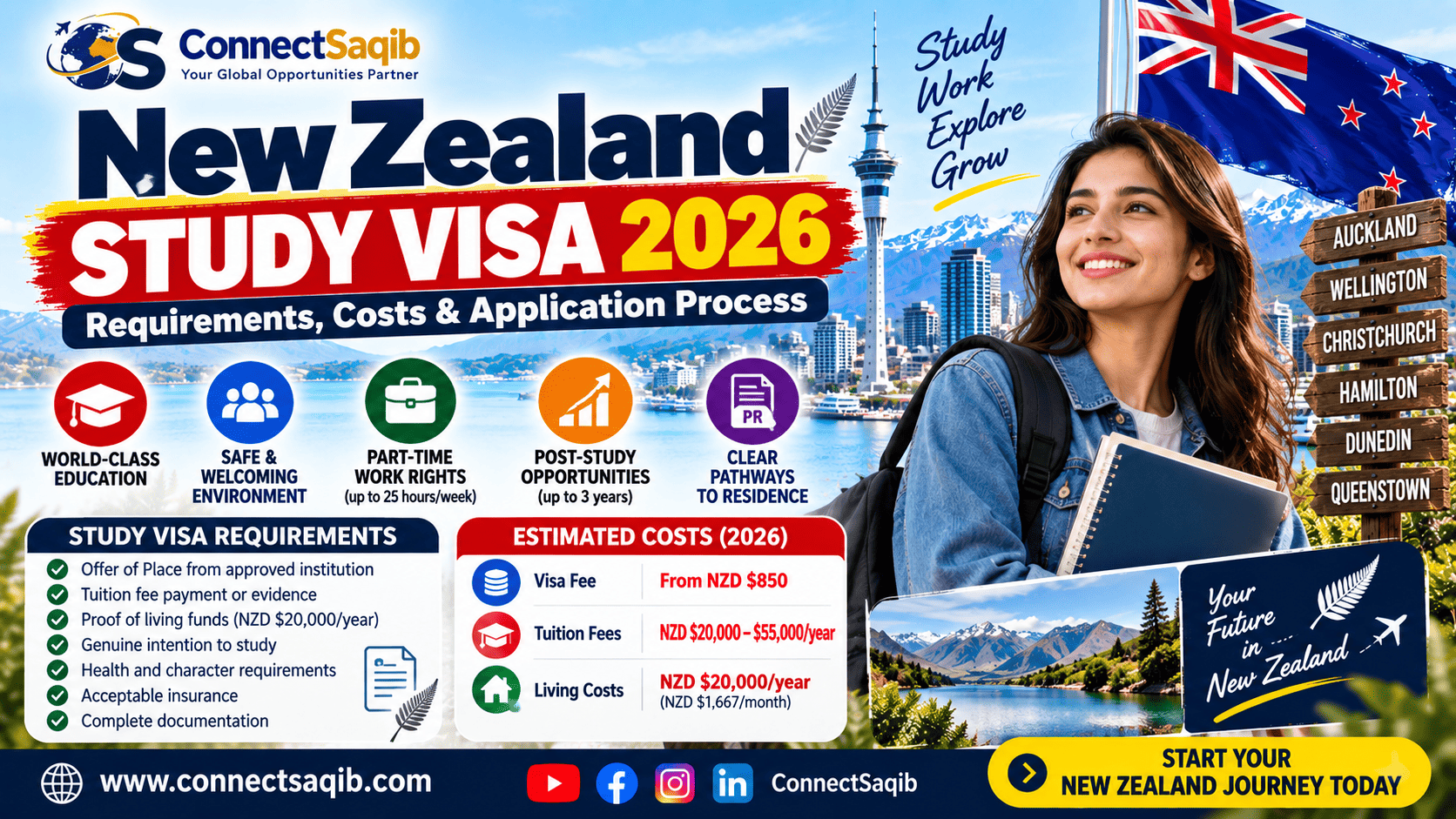
Immigration New Zealand currently lists the Fee Paying Student Visa at a cost from NZD $850, with the visa allowing eligible students to stay for up to four years depending on their study and visa conditions. Immigration New Zealand currently reports that 80% of applications are processed within eight weeks, although actual processing times vary by education provider and application circumstances.
This complete guide explains the New Zealand Study Visa 2026 requirements, costs, financial proof, documents, work rights and application process.
What Is the New Zealand Study Visa?
The Fee Paying Student Visa allows eligible international students to study full-time in New Zealand at an approved education provider.
It is generally used by students who are paying their own tuition fees or whose studies are being funded by family members, a loan, scholarship or other acceptable financial arrangement.
To apply, students normally need an Offer of Place from an approved education provider and must demonstrate that they can pay their tuition fees and living expenses.
The visa can normally cover the period of study that has been paid for, subject to passport validity and other visa conditions, with a maximum duration of up to four years for the Fee Paying Student Visa.
New Zealand Study Visa Requirements 2026
Applicants need to satisfy several requirements before Immigration New Zealand can approve a student visa.
1. Offer of Place
You must have an offer of place from an approved New Zealand education provider.
Your institution may be a university, institute of technology, polytechnic, private training establishment or another approved provider depending on the programme.
The education provider must also meet the applicable requirements under New Zealand’s international education framework.
2. Tuition Fee Evidence
You need to demonstrate that you can pay your tuition fees.
Normally, applicants need evidence showing that they have paid the tuition fees for one course or one year of study, whichever is shorter.
Students applying from outside New Zealand may also choose an Approval in Principle (AIP) approach in eligible circumstances, allowing them to obtain approval in principle before paying tuition fees. Tuition payment evidence must then be provided before the visa can be granted.
3. Financial Proof
Financial evidence is a major part of a New Zealand student visa application.
For tertiary-level study, English-language study and other non-compulsory education, Immigration New Zealand currently requires evidence of:
NZD $20,000 per year, or
NZD $1,667 per month if the course is shorter than one year.
For compulsory school education from Years 1–13, the requirement is currently NZD $17,000 per year or NZD $1,417 per month.
The money must be genuinely available to support you while you are in New Zealand.
Depending on your circumstances, evidence may include bank statements, fixed-term deposits, education loans, scholarships, sponsorship arrangements or a Financial Undertaking for a Student.
Immigration New Zealand may also ask for evidence showing the source of the funds.
4. Genuine Intention to Study
Applicants must demonstrate that they genuinely intend to study in New Zealand and comply with their visa conditions.
Immigration New Zealand assesses applications individually and considers the information and supporting evidence provided.
For this reason, your chosen course should make sense in relation to your previous education, work experience and future career plans.
5. Health and Character
Students must meet applicable health and character requirements.
Depending on your circumstances, Immigration New Zealand may require:
- Medical examination
- Chest X-ray
- Police certificate
- Other supporting health or character evidence
Requirements can vary according to your age, nationality, intended stay and previous travel or immigration history.
6. Health and Travel Insurance
International students must agree to have acceptable insurance covering travel and healthcare requirements for their stay.
Your education provider will normally explain the insurance requirements and may arrange an appropriate policy.
New Zealand Study Visa Costs 2026
Students should budget for more than the visa application fee.
Immigration Costs
Immigration New Zealand currently lists the Fee Paying Student Visa cost as:
From NZD $850
The exact amount can depend on nationality, location and applicable charges, so applicants should verify the final amount using Immigration New Zealand’s official fee tool before applying.
Tuition Fees
Tuition depends heavily on your institution, qualification and subject.
As a general guide published by Study with New Zealand:
| Study Level | Approximate International Tuition |
|---|---|
| Diploma/Certificate | Varies significantly |
| Bachelor’s degree | About NZD $35,000–$55,000 per year |
| Postgraduate degree | About NZD $20,000–$45,000 |
| PhD | About NZD $6,500–$7,500 per year for most subjects |
Medicine, veterinary science and certain specialist programmes can cost considerably more. Exact fees should always be confirmed with the education provider.
Living Costs
For visa purposes, tertiary students generally need to demonstrate at least NZD $20,000 per year for living expenses.
Actual living costs can be higher or lower depending on accommodation, city and lifestyle.
Study with New Zealand gives examples of annual living costs of approximately NZD $20,000–$27,000 in Auckland and Wellington, while some students in Dunedin may have lower estimated costs.
Typical expenses include:
- Accommodation
- Food
- Electricity
- Transportation
- Mobile phone
- Internet
- Personal expenses
- Insurance
Can New Zealand Students Work While Studying?
Yes, eligible student visa holders may have work rights, but the exact conditions depend on the course and visa conditions.
Many eligible students can work up to 25 hours per week during their studies and may be able to work full-time during scheduled holidays.
However, students should always check the work conditions printed on their eVisa rather than assuming they automatically have work rights.
Some postgraduate students, including eligible students undertaking a New Zealand master’s by research or doctoral degree, can have broader work rights under specific immigration conditions.
Working should be viewed as a way to gain experience and help with expenses rather than as a replacement for the financial evidence required for the visa.
Documents Required for a New Zealand Student Visa
A typical application may require:
- Valid passport
- Recent acceptable photograph
- Offer of Place
- Tuition fee receipt or evidence of ability to pay
- Financial evidence
- Evidence showing the source of funds
- Education documents
- Academic transcripts
- English-language evidence where required by the institution or course
- Medical documents, if required
- Chest X-ray, if required
- Police certificate, if required
- Evidence of accommodation or accommodation arrangements where relevant
- Evidence of onward travel or sufficient funds to purchase a ticket
- Scholarship or education-loan documentation where applicable
- English translations of documents that are not in English
Immigration New Zealand specifically requires applicants to provide evidence of tuition payment or ability to pay, sufficient living funds and other supporting documentation relevant to their circumstances.
New Zealand Student Visa Application Process 2026
The process can be divided into several stages.
Step 1: Choose Your Course
Start by identifying a course that matches your academic background and career objectives.
Consider:
- Qualification level
- Course duration
- Tuition fee
- Entry requirements
- Location
- Career opportunities
- Post-study options
Step 2: Apply to an Education Provider
Submit your academic and supporting documents to the chosen institution.
If accepted, you should receive an Offer of Place.
Step 3: Prepare Your Financial Evidence
Arrange evidence for your tuition fees and living expenses.
Do not wait until the final stage to organise your financial documents. Immigration New Zealand may examine whether funds are genuinely available and, where appropriate, request evidence of their source.
Step 4: Prepare Visa Documents
Prepare your passport, Offer of Place, tuition evidence, financial documents, academic documents, medical or police certificates where required, and other supporting evidence.
Documents that are not in English generally need appropriate certified English translations.
Step 5: Submit the Online Application
Most international students apply online through Immigration New Zealand.
Upload the required documents and pay the applicable visa fee.
Step 6: Respond to Immigration New Zealand
Immigration New Zealand may request additional information or documents.
Respond accurately and within the specified deadline.
Step 7: Receive Your Visa Decision
If your application is approved, you will receive your student visa/eVisa with conditions relating to your study, work rights and other requirements.
New Zealand Student Visa Processing Time 2026
Processing times change throughout the year.
Immigration New Zealand currently recommends applying at least three months before your intended travel date.
Current published processing data shows differences depending on the education provider. In the latest four-week data, universities had an average processing time of approximately 2.5 weeks, with most applications completed within 5.5 weeks. Polytechnics and private training establishments had average processing times of about 5 weeks, with most completed within 9 weeks.
These are not guarantees. Processing can take longer if an application requires additional assessment or information.
Students applying from Pakistan are specifically encouraged to apply early because Immigration New Zealand notes higher application volumes from Pakistan and several other South Asian countries.
New Zealand Study Visa for Pakistani Students
New Zealand remains an option for Pakistani students looking for undergraduate, postgraduate, doctoral and vocational education.
Applicants from Pakistan should pay particular attention to:
Strong Financial Documentation
Your financial documents should clearly demonstrate that the required funds are genuinely available.
Where necessary, be prepared to explain the source of significant deposits or financial support.
Academic Progression
Your proposed programme should have a logical connection with your previous studies and career plans.
For example, moving from a bachelor’s degree in business into a relevant master’s programme may provide a straightforward academic progression.
A major unexplained change in academic direction may require stronger supporting evidence explaining the purpose of the new study.
Genuine Study Plan
Explain why you selected:
- New Zealand
- The particular institution
- The particular qualification
- The subject area
- Your intended career direction
The objective is to present a clear and credible study plan supported by documentation.
Apply Early
Immigration New Zealand recommends applications at least three months before intended travel, and specifically highlights Pakistan among countries where students should be particularly mindful of applying early.
Can Students Stay in New Zealand After Graduation?
Graduating from a New Zealand institution may provide access to post-study work options depending on the qualification, study programme and immigration rules that apply when you graduate.
Study with New Zealand states that eligible graduates may be able to obtain a Post Study Work Visa for up to three years, depending on what they studied and the level of their qualification.
Students should not treat a student visa as an automatic pathway to residence. Future immigration options depend on the qualification, occupation, employment, salary and immigration rules applicable at that time.
Common Reasons Students Should Strengthen Their Applications
Before submitting a New Zealand student visa application, review the following areas carefully:
Financial Evidence
Make sure your financial evidence is consistent, genuine and sufficiently documented.
Course Selection
Choose a programme that has a reasonable connection with your academic and professional background.
Documentation
Missing documents can result in delays or requests for further information.
Immigration History
Previous visa refusals, overstays or immigration issues should be addressed honestly where relevant.
Study Plan
A clear explanation of your academic and career objectives can help present your application coherently.
New Zealand Study Visa 2026: Estimated Budget
A student should plan for several categories of expenditure:
| Expense | Typical Planning Range |
|---|---|
| Student visa | From NZD $850 |
| Bachelor’s tuition | NZD $35,000–$55,000/year |
| Postgraduate tuition | NZD $20,000–$45,000/year |
| PhD tuition | Around NZD $6,500–$7,500/year for most subjects |
| Visa living-funds requirement | NZD $20,000/year |
| Insurance | Depends on provider/policy |
| Flights | Depends on departure city and season |
Tuition figures are indicative rather than fixed. Students should obtain an official fee quote from their chosen institution before calculating their total budget.
Frequently Asked Questions
Is IELTS mandatory for a New Zealand student visa?
There is not one universal IELTS score that applies to every student visa applicant. English-language requirements can depend on the education provider, course and visa circumstances.
Your institution may require IELTS, PTE, TOEFL or another accepted form of English evidence for admission.
How much bank balance is required for a New Zealand student visa?
For tertiary study, the current immigration living-cost requirement is NZD $20,000 for one year, or NZD $1,667 per month for courses shorter than one year. Tuition fees are separate from this amount.
Can I work while studying in New Zealand?
Eligible students may be allowed to work up to 25 hours per week during study and full-time during certain scheduled holidays, depending on their visa conditions.
How long does a New Zealand student visa take?
Processing varies. Immigration New Zealand currently recommends applying at least three months before intended travel. Current published processing data differs by education provider.
Can I bring my family?
There are different visa options that may allow eligible students to have partners or dependent children join them, depending on the student’s visa, programme and circumstances.
Can I apply for a New Zealand student visa from Pakistan?
Yes. Pakistani citizens can apply for a New Zealand student visa if they meet the relevant immigration and education requirements. Immigration New Zealand specifically advises applicants from Pakistan to apply early because application volumes can be high.
Conclusion
The New Zealand Study Visa 2026 process involves much more than simply receiving admission from a university or college. Students need to demonstrate genuine study intentions, secure an Offer of Place, arrange tuition payment or acceptable evidence, demonstrate sufficient living funds, satisfy health and character requirements and provide complete supporting documentation.
For tertiary students, the current immigration financial requirement is NZD $20,000 per year for living expenses, in addition to tuition fees. Eligible students may also have work rights of up to 25 hours per week, depending on their visa conditions.
For Pakistani students, careful financial documentation, logical course selection and early preparation are particularly important. Immigration New Zealand recommends applying at least three months before intended travel.
Always verify the latest requirements, fees and processing times directly with Immigration New Zealand before submitting an application because immigration rules and fees can change.
Related Articles on ConnectSaqib
- New Zealand Skilled Migrant Category 2026: Complete Guide
- New Zealand AEWV 2026: Complete Guide
- New Zealand AEWV Nurse Jobs 2026
- New Zealand AEWV Accountant Jobs 2026
- Tech Careers in New Zealand 2026
- New Zealand Green List Jobs 2026
- Study in New Zealand 2026: Courses, Fees & Career Opportunities
Official Sources
Immigration New Zealand — Fee Paying Student Visa
Immigration New Zealand — Student Fund Requirements
Immigration New Zealand — Student Visa Wait Times
Study with New Zealand — Tuition Fees and Cost of Living